



HOME
THINKING BLUE SKY
SKIES
WHAT IS UP THERE?
WHERE HAVE ALL THE GODS GONE?
HOW TO TAME THE SKY?
CORY ARCANGEL
LISE AUTOGENA
GASTON BACHELARD
JAMES BENNING
CORREGGIO
GILLES DELEUZE
SIMON FAITHFULL
CAMILLE FLAMMARION
WERNER HERZOG
DEREK JARMAN
GERHARD RICHTER
JACQUES TATI
JOELLE TUERLINCKX
RICHARD WILSON
PETER WEIR
QUADRATURA
WHAT OF OUR PLANETARY SKY?
ABOUT
REFERENCES
WHERE HAVE ALL THE GODS GONE?
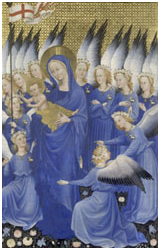
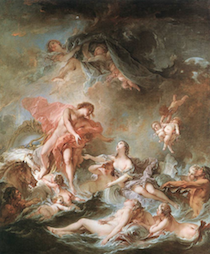
Didn't the skies used to be brim-full of gods, demi-gods, divinities, cherubs and saints. What has happened to them all? Where is the arching body of the Egyptian sky-goddess Nut, the angelic army of The Wilton Diptych, or the massing throng of Correggio’s Assumption of the Virgin? Where are the mythical figures of Ovid (the like of which inspired Boucher’s erotically charged compositions)? Even the resilient putti seem to have vanished.
Writing on the history and philosophy of science Alexander Koyré argues that in the Age of Enlightenment the sky was transformed from ‘theological heaven’ (i.e. a sky teaming with angels, saints and cherubs) to ‘astronomical sky’ (what Koyré characterises as 'the infinite, uncreated nothingness, the frame of the absence of all being; consequently also of God’s'). Like many others, Koyré locates this transformation as beginning with the publication of Copernicus’ On the Revolutions of the Heavenly Spheres (1543). Koyré states that "by removing the earth from the centre of the world and placing it among the planets" Copernican Astronomy "undermined the very foundations of the traditional cosmic world-order” (Koyré, 1957). In over-simplified terms, the rationalised world-order that ensued only had eyes for that which could be observed and recorded. Thus it was that the incommensurable gods and their angelic armies gradually vanished from sight.
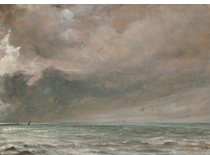
This change can be traced within the English cultural imaginary from the fifteenth century onwards. Within literary studies there are two influential accounts which detail different stages in the 'rationalization' of the sky. The first is John Hollander's Untuning of the Sky (1961) and the second is J Hillis Miller's The Disappearance of God (1963): with reference to English poetry, the former argues that by the mid-seventeenth century the sky's deeply speculative resonance, its magic, was depleted or 'trivialised' within mainstream culture; the latter explores the way the 'blue sky with its empty depths' operates as an image of absolute solitude within Victorian literature. To my knowledge there are no such accounts within art history, or none as granular as either Hollander's or Hillis Miller's. However, the transformation is self-evident. As John Ruskin observed: “whereas the medieval never painted a cloud but with the purpose of placing an angel upon it… we should think the appearance of an angel in the cloud wholly unnatural” (Ruskin, 1853). Writing in the nineteenth century, Ruskin compares the heavily populated skies of medieval painters, for whom a cloud indicated the presence of some divine being, with the meteorological skies of nineteenth century landscape painters. Hubert Damisch describes this transformation as a move away from “the norms of Medieval symbolism” toward painting that “stood for conditions and rules of a type of ‘objective’ representation” (Damisch, 1972)
However, just because divine figuration vanished from the heavens and the emergent genre of landscape painting engaged with notions of objectivity, what John Ruskin termed 'the truth of the sky', we should not be lulled into the misconception that the sky was fully 'rationalised' and as such ceased to operate as a site of divination. Ruskin did not believe this, and nor should we. While an empty sky may appear as a neutral backdrop, passive and constant, it is anything but. In his recent book Gods in the Sky: Astronomy, Religion and Culture (2001) historian of sciences, Allan Chapman argued that “just like all the hundreds of generations that have preceded us, it is still to the sky that modern people look for answers to their profoundest questions” (Chapman, 2001). Surely we need to understand the way in which our meteorological sky answers the questions previously asked of our gods?
- Images (top to bottom):
- 'The Wilton Diptych' c.1395-9, wooden altarpiece;
- François Boucher ‘The Setting of the Sun’ 1752, Oil on canvas;
- John Constable, ‘The Sea at Brighton’, 1 January 1826. Notation on back: 'Brighton. Sunday. Jany. 1st. 1826. From 12 till 2 P.M. Fresh breeze from S.S.W.' (Tate Gallery, London)