




HOME
THINKING BLUE SKY
SKIES
ABOUT
REFERENCES
THINKING
BLUE SKY
John Ruskin was one of the greatest proponents of nineteenth century ‘thinking blue sky’. He wrote: “It is a strange thing how little in general people know about the sky… we never make it a subject of thought”. He continued: "it is the part of creation in which nature has done more for the sake of pleasing man, more, for the sole and evident purpose of talking to him and teaching him, than in any other of his works" (Ruskin, 1843). Ruskin's prolific and impassioned writing on the "simple, open blue of the sky" (Ruskin, 1843), bound up as this was with the elevation of landscape painting to a celebrated and much discussed genre, brought the aesthetics of the sky to public attention. So too did the work of nineteenth century atmospheric scientists Lord Rayleigh and John Tyndall who answered the age old question 'why is the sky blue?'. John Ruskin, Lord Rayleigh and John Tyndall all contributed to the changing conception of the sky during nineteenth century Romanticism.
In the latter part of the twentieth century and early twenty-first century the subject of the earthly blue sky has once again fallen into neglect. It is widely admired. It is analysed within observational and historical science. Yet, while remaining a potent symbol within contemporary culture, it is rarely made a subject of (aesthetical or philosophical) thought. The most recent account of the aesthetics of the blue sky is to be found in the work of french philosopher Gaston Bachelard. Bachelard was writing in the mid-twentieth century, yet his frame of reference earned him the title 'the last romantic'. In simple terms, the sky he wrote of was a Romantic sky.
Is it not time we turned our thoughts once again to the blue sky to see what might be up there hidden in plain view? Is it not time we responded to Janet Cardiff's 'Boo!' and sought out the skies that inform and define our twenty-first century lives?
John Ruskin was one of the greatest proponents of nineteenth century ‘thinking blue sky’. He wrote: “It is a strange thing how little in general people know about the sky… we never make it a subject of thought”. He continued: "it is the part of creation in which nature has done more for the sake of pleasing man, more, for the sole and evident purpose of talking to him and teaching him, than in any other of his works" (Ruskin, 1843). Ruskin's prolific and impassioned writing on the "simple, open blue of the sky" (Ruskin, 1843), bound up as this was with the elevation of landscape painting to a celebrated and much discussed genre, brought the aesthetics of the sky to public attention. So too did the work of nineteenth century atmospheric scientists Lord Rayleigh and John Tyndall who answered the age old question 'why is the sky blue?'. John Ruskin, Lord Rayleigh and John Tyndall all contributed to the changing conception of the sky during nineteenth century Romanticism.
In the latter part of the twentieth century and early twenty-first century the subject of the earthly blue sky has once again fallen into neglect. It is widely admired. It is analysed within observational and historical science. Yet, while remaining a potent symbol within contemporary culture, it is rarely made a subject of (aesthetical or philosophical) thought. The most recent account of the aesthetics of the blue sky is to be found in the work of french philosopher Gaston Bachelard. Bachelard was writing in the mid-twentieth century, yet his frame of reference earned him the title 'the last romantic'. In simple terms, the sky he wrote of was a Romantic sky.
Is it not time we turned our thoughts once again to the blue sky to see what might be up there hidden in plain view? Is it not time we responded to Janet Cardiff's 'Boo!' and sought out the skies that inform and define our twenty-first century lives?
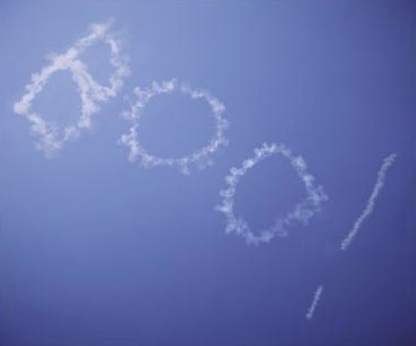
A work by Janet Cardiff, sky writing,
part of a series 'En el Cielo' (2001)




