



HOME
THINKING BLUE SKY
SKIES
WHAT IS UP THERE?
WHERE HAVE ALL THE GODS GONE?
HOW TO TAME THE SKY?
CORY ARCANGEL
LISE AUTOGENA
GASTON BACHELARD
JAMES BENNING
CORREGGIO
GILLES DELEUZE
SIMON FAITHFULL
CAMILLE FLAMMARION
WERNER HERZOG
DEREK JARMAN
GERHARD RICHTER
JACQUES TATI
JOELLE TUERLINCKX
RICHARD WILSON
PETER WEIR
QUADRATURA
WHAT OF OUR PLANETARY SKY?
ABOUT
REFERENCES
WHAT IS UP THERE?
Stephen Hawking writes of the fact that "we go about our daily lives understanding almost nothing of the world... few of us spend much time wondering why nature is the way it is…". He suggests that children are the exception for they "don’t know enough not to ask the important questions" (Hawking, 1988). In the early stages of this research it was a child, my nephew (then six), who asked one such important question. He simply pointed to the heavens and said 'what is up there?'. I found myself unable to answer in any straightforward and yet satisfactory way.
Upon reflection I understood my nephew's question to be about the geographical terrain known as 'the sky', a space defined as 'the region of the atmosphere and outer space seen from the earth, and in addition the weather or climate evidenced by this’ (Concise Oxford Dictionary). Surely this understanding of the sky is just too broad? This, and other similar definitions from a range of sources simply give rise to further questions: 'Is all weather sky?', 'Does the sky really only exist when seen from the earth?', 'Are Hubble’s deep-space images also sky?'. In a continued attempt to find a satisfactory answer I decided to turn from the question 'What is up there?' (i.e. ‘What is the sky?’) to the question of whether the sky can be measured.
The first form of sky-measuring I came across was that of measuring the sky’s colour and, by way of this, affirming the sky's fundamental hue as blue. While contemporary geographer Denis Wood protests at this normalising of the sky urging us to remember the myriad of colours seen in the heavens on a daily basis, it was this normalized sky that interested the first known sky-measurer, Horace-Bénédict de Saussure (1740-1799). Saussure wrote that it was not the sunsets or sunrises, not the tempests and storms but the 'perfectly pure and cloudless' sky that fascinated him. He set out to measure the degree of blueness of the air using a scale of fifty-two shades of blue ranging from white to black. With this 'Cyanometer' Saussure, and the sky-measurers that followed were able to translate colour into recordable and comparable data.
The work of these eighteenth and nineteenth century sky-measurers helped resolved an age old question: 'why is the sky blue?'. The answer lies in the phenomenon known as Rayleigh scattering: as sunlight travels through the air-molecules and small particles at the edge of the earth's atmosphere, the white light of the sun splits and a local scattering of blue light produces what the human eye sees as sky-blue. Rayleigh scattering gives us a second form of sky-measuring, that of altitude. The phenomenon of the bluing of the air, what we recognise as our earthly blue sky, occurs at the edge of the atmosphere. Since the 1950s this edge has be estimated as existing 100km (62 miles) above the earth's surface. This abstract border, the Kármán line is widely recognised both as an approximation for the point at which earth's atmosphere ends and space begins and the approximate altitude at which Rayleigh scattering blues the air.
If my nephew were to ask me once again 'what is up there?', I would now explain that some of what is 'up there' is the earthly blue sky. This sky is sunlight scattered by the thin air at the edge of the earth's atmosphere resulting in the appearance of the colour blue. Beneath the blue phenomenon of the sky we might see weather determined by the earth's climate. Beyond the earth's sky we might see the sun, stars, planets and a new array of alien skies brought to us by Hubble and deep space probes. But in between these two distinct aspects is the earth's blue sky.
This in-between sky is the sky addressed in Thinking Blue Sky. It is a sky that from the 1960s onwards has been experienced and documented as a thin threshold of blue air separating us from the beyond of Outer Space. It is a sky that can be quantified, its blueness measured and its altitude estimated. This is a sky that has distinctive cultural attributes and associations. These cultural attributes and associations are the subject of this research.

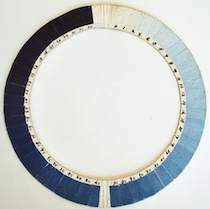
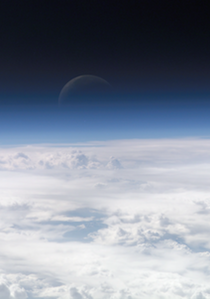
Images (top to bottom): A work by Dave Muller, sky writing, part of a series 'En el Cielo' (2001); Horace-Bénédict de Saussure's Cyanometer circa 1789; 'The Top of the Atmosphere' taken from the International Space Station 20/7/06 (Image credit: NASA)


