




HOME
THINKING BLUE SKY
SKIES
WHAT IS UP THERE?
WHERE HAVE ALL THE GODS GONE?
HOW TO TAME THE SKY?
CORY ARCANGEL
LISE AUTOGENA
GASTON BACHELARD
JAMES BENNING
CORREGGIO
GILLES DELEUZE
SIMON FAITHFULL
CAMILLE FLAMMARION
WERNER HERZOG
DEREK JARMAN
GERHARD RICHTER
JACQUES TATI
JOELLE TUERLINCKX
RICHARD WILSON
PETER WEIR
QUADRATURA
WHAT OF OUR PLANETARY SKY?
ABOUT
REFERENCES
CAMILLE FLAMMARION An ancient divide
Camille Flammarion, the nineteenth century author of texts such as The History of the Sky (1871) and The Atmosphere: Popular Meteorology (1872) documents the fact that our conception of the sky, and thereby the way we experience it, varies throughout the ages. Flammarion writes in an era in which the sky was a rich, poetic image evoking infinite plenitude and aerial depth. Furthermore, like other nineteenth century scientists and adventurers, Flammarion had direct experience of the blue expanse of the atmosphere. He had travelled into the sky in a hot air balloon and, as he claims, witnessed for himself that our ancestors' conception of the heavens was not 'real'.
He goes on to explain, "so recently as Copernicus, a large number of astronomers thought it (the sky) was as solid as plate-glass” (Flammarion, 1872). This glass sky formed part of the geo-centric, finite universe associated with the Aristotelian classical world-image as mapped by Ptolemy. The glass or crystalline sky operated as an absolute divide. It separated the sacred from the profane, the former being eternal and unchanging and the latter being subject to decay and alteration. While the gods could, and did, travel to the realm of the mortals, the journey of a mortal to the realm of the heavens was prohibited. However, within his writing, Flammarion describes illicit journeys that breached these natural laws. One account, often repeated by Flammarion, tells of “a missionary of the Middle Age” who claimed that;
…
in one of his voyages in search of terrestrial paradise, he
reached the horizon where the earth and the heavens met, and
that he discovered a certain point where they were not joined
together, and where, by stooping his shoulders, he passed
under the roof of the heavens … (Flammarion, 1872)
In
the 1888 edition of The
Atmosphere: Popular Meteorology, this story is illustrated
with a now famous wood engraving. The illustration is a pastiche
of a medieval wood cut showing the sky as a goblet curving over
the flat earth. To the right we see a figure sticking his head
and hand through the threshold of heaven. An expression of
delight and awe seems almost audible. This breaching of the sky is also traced by Alexander Koyré who (with reference to both Cicero’s De Natura Deorum and Lucretius’s De rerum natura) writes that the objection to an understanding of the world as infinite was often expressed by way of the rhetorical question: “What would happen if somebody stretched his hand through the surface of the heavens?” (Koyré, 1957), i.e. what could be beyond the celestial sphere? This question and the images that stem from it beautifully identify the classical sky as a fault-line or threshold. It is this threshold sky that re-emerges in the accounts of our Cosmonauts and Astronauts who, moving higher than Flammarion in his balloon, witness the edge of the earth's atmosphere and the finitude of the sky.
Before satellite images were in the public domain, might we not have imagined Gagarin’s journey across the sky in the style of the Flammarion wood engraving? While Gagarin’s hand would be raised in delight at proof of the absence of god and not, as in the case of Flammarion’s missionary, at his presence both reveal a sky tremulous with the possibility of rupture.
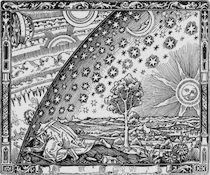
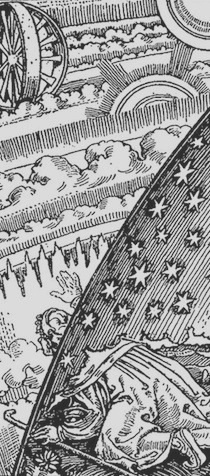
Images (top to bottom): Wood Engraving from 'The Atmosphere' by Camille Flammarion (1888 edition); detail of the Wood Engraving




