
HOME
THINKING BLUE SKY
SKIES
WHAT IS UP THERE?
WHERE HAVE ALL THE GODS GONE?
HOW TO TAME THE SKY?
CORY ARCANGEL
LISE AUTOGENA
GASTON BACHELARD
JAMES BENNING
CORREGGIO
GILLES DELEUZE
SIMON FAITHFULL
CAMILLE FLAMMARION
WERNER HERZOG
DEREK JARMAN
GERHARD RICHTER
JACQUES TATI
JOELLE TUERLINCKX
RICHARD WILSON
PETER WEIR
QUADRATURA
WHAT OF OUR PLANETARY SKY?
ABOUT
REFERENCES
RICHARD WILSON A crocked sky
Doesn't it seem strange to you that the sky is always ‘up’? Should we trust something that remains exactly where we expect it to be? Nietzsche warned: “As long as you still feel the stars as being something ‘over you’ you still lack the eye of the man of knowledge” (Nietzsche, 1886). I started to look for crocked skies.
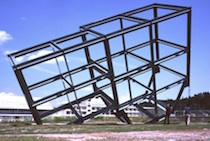
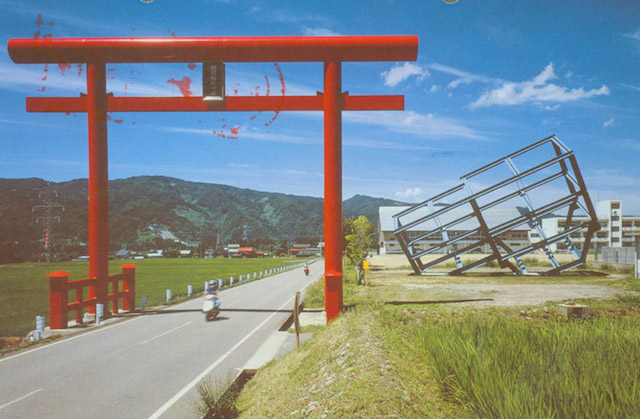
I found one in a work by Richard Wilson. Wilson is an artist who does the unexpected. He has cut and rotated a section of a building (Over Easy), shrunk a dissected boat (A Slice of Reality) and famously half-filled a room with engine oil (20:50). Each of the above challenges our sense of everyday reality by changing or transforming something familiar. In comparison, Set North for Japan (74° 33’ 2") is unexpected because it refuses change. Installed in Nakasato, Japan, the metal outline of the artist’s London home is not scaled, not cut and importantly, not rotated. The frame is not altered to accommodate the curvature of the earth but maintains what Wilson describes as 'its exact English perpendicular and horizontal orientation to True North'. For this reason the version of the house we see in Nakasato appears crocked: the roof pitches into the earth, and its foundations are built in the sky. However, once we understand that the orientation of the house is correct according to its exact English orientation, then we are forced to consider the changing orientation of the earth and sky.
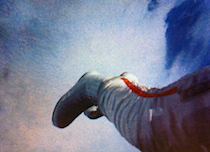
We live in a planetary age in which, in the words of Paul Virilio, “everything is being turned on its head... not only geopolitical boundaries but those of perspective geometry” (Virilio, 1997). Set North for Japan (74° 33’ 2") reminds us of this. It makes us aware of the fact that our skies are not only up above but, as captured in the image of Leonov walking in orbit above the earth, they are also below.
We need to pay more attention to our sky for it is on the move. It is no longer to be found exactly where we expect it to be.
Images (from top to bottom):
'Set North For Japan' 74 33' 2", Echigo Tsumari Project, Niigata Perfecture, Japan (2000)
‘Set North for Japan’ postcard which has travelled back around the globe from Nakasato to London.
Alexei Leonov, his legs visible outside the Vostok 2 space craft on 18 March 1965 (@ Ria Novosti/Science Photo Library)