




HOME
THINKING BLUE SKY
SKIES
WHAT IS UP THERE?
WHERE HAVE ALL THE GODS GONE?
HOW TO TAME THE SKY?
CORY ARCANGEL
LISE AUTOGENA
GASTON BACHELARD
JAMES BENNING
CORREGGIO
GILLES DELEUZE
SIMON FAITHFULL
CAMILLE FLAMMARION
WERNER HERZOG
DEREK JARMAN
GERHARD RICHTER
JACQUES TATI
JOELLE TUERLINCKX
RICHARD WILSON
PETER WEIR
QUADRATURA
WHAT OF OUR PLANETARY SKY?
ABOUT
REFERENCES
WHAT OF OUR PLANETARY SKY?
We live in a planetary age. Our visual culture is saturated with images beamed in from spaceships, satellites and telescopes many of which are in orbit around the earth documenting our planet's climate and oceans and, likewise, enabling twenty-first century global communications. The Blue Marble (1972), the first image of the earth as a planetary orb, can be read as marking a shift in twentieth century consciousness. It is the most widely reproduced image in history and was voted by Life Magazine as the image ‘that changed the world’. Cultural historian Robert Poole argues that as a result of the Apollo years, spanning Earthrise in 1968 and The Blue Marble in1972, "the image of the Earth was everywhere; it seemed to some to mark ‘a new phase of civilisation’, the beginning of the ‘age of ecology’" (Poole, 2008).
But what of our planetary sky? What of the 'narrow belt' or 'blue limb' that emerges with this planetary perspective? What role has this played in the visual culture of 'a new phase of civilisation'? In simple terms, very little. Photographs such as Earthrise and The Blue Marble were taken from too great a distance to capture the local scattering of blue light that constitutes our planetary sky, thus the images that define this period feature a clean-edged, haze-free earth. And yet even before the Apollo photographs were in mass circulation the aesthetics of an earth without its aerial haze were imprinted on the public consciousness. In his account of the changing image of the planet earth view from Outer Space, Robert Poole traces the fact that “until the 1960s, artists depicting planet Earth all imagined it (the earth) pretty much the same way… they showed a geographical globe floating in space on a sunny day” (Poole, 2008). Chesley Bonestell’s now famous artwork featured on the front cover of Beyond the Solar System (1964) is indicative of this early tendency. Stanley Kubrick's 2001: A Space Odyssey (1968) went on to affirm and inform the cultural imaginary of an earth endowed with the precise curvature of a modernist sculpture.
Towards the end of the twentieth century the dominance of the image of the earth as a haze-free orb floating in Space was being challenged. Evidently a shift to space programmes such as the International Space Station, which has been in near-earth orbit since 1998, informed this changing aesthetic. However, the popularity of this new cultural imaginary was not only evident in NASA's daily publication of images but can be traced throughout contemporary culture. Within the genre of science fiction, Luc Besson’s The Fifth Element (1997) is a turning point. Like Kubrick, Besson's treatment of the earth allows the audience to spend time absorbing the beauty of the earth as a planetary object. However, what is distinctive is the fact that Besson's earth glows with a blue haze and, as such, has more in common with Kubrick's mysterious star child than his modernist marble.
In recent years the potency of the image of an ethereal earth with its blue halo of a sky has gathered momentum. In 2012 Universal Studios, whose logo has been an image of the globe for over a century, moved from clean-edged earth to ethereal-hazed planet. The following year it released Joseph Kosinski's Oblivion (2013), which along with Neil Blomkamp's Elysium (2013) and Alfonso Cuarón's Gravity (2013) forms a trilogy of near-earth science fiction films all of which feature a beautiful, blue-limbed earth. Of the three it is Gravity’s depiction of earth that demands most attention. As Alfonso Cuarón explains the earth has a deep metaphorical value within the film, he describes it as “the ever present character in the background” (Cuarón, 2013). The presence of the ethereal planet is to Cuarón’s Gravity as New York is to Woody Allen’s Manhattan (1979), or the desert is to Michelangelo Antonioni’s Zabriskie’s point (1970). The aesthetics of each of these locations, carefully framed and shot by each of these directors, seep into our consciousness where they plant themselves and become a touchstone for meaning. How this meaning resonates needs careful divining.
New writing on the planetary blue sky and how it makes meaning in films such as Alfonso Cuaron’s 'Gravity' is coming soon.
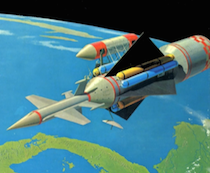
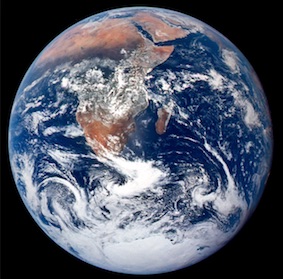
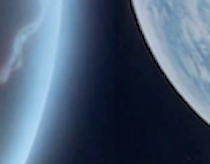


Images (from top to bottom):
Chesley Bonestell, artwork featured on the front cover of 'Beyond the Solar System', 1964; 'Blue Marble', 1972 (Image Credit NASA); still from '2001:A Space Odyssey', 1968; still from 'The Fifth Element', 1997,
and still from 'Gravity', 2013.




