




HOME
THINKING BLUE SKY
SKIES
WHAT IS UP THERE?
WHERE HAVE ALL THE GODS GONE?
HOW TO TAME THE SKY?
CORY ARCANGEL
LISE AUTOGENA
GASTON BACHELARD
JAMES BENNING
CORREGGIO
GILLES DELEUZE
SIMON FAITHFULL
CAMILLE FLAMMARION
WERNER HERZOG
DEREK JARMAN
GERHARD RICHTER
JACQUES TATI
JOELLE TUERLINCKX
RICHARD WILSON
PETER WEIR
QUADRATURA
WHAT OF OUR PLANETARY SKY?
ABOUT
REFERENCES
PETER WEIR Touching the sky
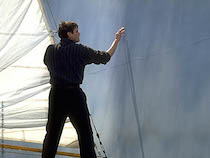
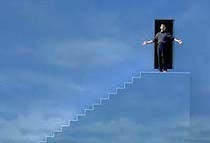
Our contemporary sky is changing. It no longer makes meaning as an indefinite expanse of blue air but rather as a thin blue boundary encircling the globe. Nowhere within contemporary culture is this change more clearly expressed than in the cinematic world of Peter Weir’s The Truman Show (1998). Weir’s fictional character, Truman, encounters this threshold sky in the final scenes of the film in which we watch the protagonist, played by Jim Carey, attempting to escape from his island home. At the start of the film Truman’s ingrained fear of the sea has prohibited this journey. In the dénouement he overcomes his trepidation and escapes from his island home. The shooting script reads as follows:
Truman
continues to steer his wrecked sailboat towards the
infinitely receding horizon. All is calm until we see the
bow of the boat suddenly strike a huge, blue wall, knocking
Truman off his feet. Truman recovers and clambers across the
deck to the bow of the boat. Looming above him out of the
sea is a cyclorama of colossal dimensions. The sky he has
been sailing towards is nothing but a painted backdrop.
Truman looks upward, straining his eyes to see the top of
the sky, but it curves away at a steep angle beyond his
sight. Clinging to the boat with one hand, he tentatively
reaches out towards the painted cyclorama. He touches the
sky. He looks about him and simply laughs. (Niccol,
1998)
With
a clunk, that which would have rendered Flammarion
speechless in his hot-air balloon, the protagonist of the
film realises that this blue backdrop, what seems like an
infinite space unfolding before his eyes is, in fact, a
solid limit. It is a threshold that marks the edge of his
known world. Peter Weir’s film is remarkable no only for the fact that the solid blue backdrop acts as a motif by way of which we can understand today’s shifting conception of the earthly sky, but also because it speaks of blue-sky thinking within the progressive vision of late modernity. The opening scenes of The Truman Show introduce us to a paradise on earth, the town of Seahaven. The director states that he wanted the setting for the film to be ‘the ideal place, a dream haven, always to be sunny except when they wanted to make it rain’ (Weir, 2005). This perfect world, a world that speaks of 1950s adverts, is established as we watch the cherubic-faced protagonists move around the pastel-coloured, picket-fenced, golden-beached dream-town. In this town the radio presenter begins each day with the greeting, ‘another beautiful day in paradise folks’. Yet from the very first scene of the film there are slippages in the harmony, a studio light falls from the sky and actor-feeds slip into the sound-scape of Truman's world via the car-radio. This is just the beginning. Soon we realise that the constructed world of The Truman Show offers us a biting critique of the American Dream: we witness the perfect house, the perfect wife, the perfect world of Seahaven characterised as an illusion, more than that, a marketing strategy to sell a life-style. By the end of the film it becomes apparent that Peter Weir is speaking directly to us today. He is willing us to choose something other than televised spectacle, something other than a highly commodified dream of the future for this dream is as shallow and delimiting as the solid sky of Seahaven's stage-set cyclorama.
An
extract from ‘Blue-Sky Thinking’, a chapter in Ricarda
Vidal and Ingo Cornils (eds), Alternative Worlds
(Oxford:Peter Lang, 2015)

Images:
stills 'The Truman Show' (1998)



