




HOME
THINKING BLUE SKY
SKIES
WHAT IS UP THERE?
WHERE HAVE ALL THE GODS GONE?
HOW TO TAME THE SKY?
CORY ARCANGEL
LISE AUTOGENA
GASTON BACHELARD
JAMES BENNING
CORREGGIO
GILLES DELEUZE
SIMON FAITHFULL
CAMILLE FLAMMARION
WERNER HERZOG
DEREK JARMAN
GERHARD RICHTER
JACQUES TATI
JOELLE TUERLINCKX
RICHARD WILSON
PETER WEIR
QUADRATURA
WHAT OF OUR PLANETARY SKY?
ABOUT
REFERENCES
JAMES BENNING The 'untruth' of the sky
James Benning’s Ten Skies (2004) is a film of ten different skies each filmed for ten minutes. It includes no other visual reference. No framing by way of a horizon. No focal point by way of the sun or moon. The soundtrack seems to give clues about each of the ten locations and the audience work hard to establish a sense of place for each sky.
I first saw the film at the 2005 London Film Festival. There was a director’s Q&A after the screening. What I remember most clearly of the discussion was Benning grinning mischievously as he was questioned about the soundtrack. He stated that the audio was all recycled from his other films and therefore had no connection with the featured skies and their locations. His grin was indicative of that fact that he knew what he was doing. He knew that the audience had attempted to locate these skies and drew heavily on the soundtrack to do so. As I processed his answer it dawned on me that Ten Skies featured ten beautiful, thought-provoking skies that were nonetheless not quite true. In Philip K Dick’s Do Androids Dream of Electric Sheep (1968) the world tumbles into chaos with the revelation that brush-strokes have been spotted on the surface of heaven. When Peter Weir’s Truman stretches out his hand and touches the artificial sky under which he has dreamed all his life, everything he has known is torn a part. While Benning's revelation as to the 'untruth' of his skies didn’t topple my world into a cycle of violence, the shock of this artifice set a butterfly loose in my brain.
Years after first seeing Ten Skies I was still thinking of this film. I contacted James Benning in the hope that he would tell me more.
RS
(Rachel Steward): I think of 'Ten Skies' as doing
something similar to John Constable’s
‘sky-ing’,
for like Constable’s
‘cloud
studies’,
'Ten Skies' seems to speak of the constant yet changing
nature of the sky, each sky is both particular and
universal. Was this an aspect you set out to explore?
JB
(James Benning): Well, yes. I made Ten
Skies
in southern California, and as the song says, it never rains
in southern California, which of course isn’t true. It
sometimes rains for two weeks straight, but not that often. So
I was aware that this would be a very difficult place to make
a film about the sky, that is, about a sky that changes. I
shot it over a year period, constantly waiting for rain,
because the sky would always become quite interesting after
the rain passed. But I also looked for things on the ground
that effect the sky– like a large out of control brush fire,
upward currents off a hillside on a extremely hot day,
industrial processes at full tilt, etc. But nevertheless,
whatever is in the sky, it is always the sky with some amount
of moisture and whatever pollutants that moisture can carry.
RS:
In moving to the subject of the sky (which also features
heavily in '13 Lakes') I wondered if you also moved closer
to the limits of image making? The sky, particularly the
blue sky, seems to make meaning as a condition of visibility
rather than as what is made visible.
JB:
Whenever one makes a film image, you lasso what is out there.
You put a frame around something and ignore the rest. This is
very interesting to me when the sky is the subject, because
the sky is continuous, infinite, in fact, the film Ten
Skies
isn’t
possible, because ten skies aren’t
possible–
there is only one sky... When I first started filming I
thought Ten
Skies
would be an anti-war film, because of its serenity. But now I
don’t see Ten
Skies
as being calm, it is both violent and quite mysterious.
Email interview with James Benning, September 2011

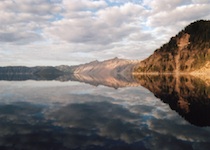
Images (top to bottom): stills from James
Benning's 'Ten Skies' (2004) and '13 Lakes' (2004)



