


HOME
THINKING BLUE SKY
SKIES
WHAT IS UP THERE?
WHERE HAVE ALL THE GODS GONE?
HOW TO TAME THE SKY?
CORY ARCANGEL
LISE AUTOGENA
GASTON BACHELARD
JAMES BENNING
CORREGGIO
GILLES DELEUZE
SIMON FAITHFULL
CAMILLE FLAMMARION
WERNER HERZOG
DEREK JARMAN
GERHARD RICHTER
JACQUES TATI
JOELLE TUERLINCKX
RICHARD WILSON
PETER WEIR
QUADRATURA
WHAT OF OUR PLANETARY SKY?
ABOUT
REFERENCES
GILLES DELEUZE: Ghost-sky
To assume that the blue sky is an image addressed in the late twentieth century philosophical model of Gilles Deleuze and Félix Guattari would not be misguided. This assumption would be based on two facts. Firstly that Deleuze and Guattari pay careful attention to images of the natural world, specifically when these images are the landscape in which one "find one’s bearings in thought” and, as such, are images that shape “the image thought gives itself of what it means to think” (Deleuze and Guattari, 1991). Secondly, the thought Deleuze and Guattari champion is creative, it involves the imagination. They argue that philosophical thought must 'invent', 'fabricate', 'create', in fact Deleuze and Guattari 's conception of philosophical thought could be characterised as ‘blue sky thinking’ if this term is understood as standing for a truly speculative imaginary unsullied by a neoliberal aspirant. How strange then that their investigation of the images that inform the way we create new ideas almost entirely overlooks the image of the sky.
When these two materialist philosophers do allude to the sky, something that happens occasionally within their writing, it could be argued that they speak of its historical resonance within traditional philosophy. Inherent in traditional philosophy is the concept of transcendence which, in their influential guide and glossary to Deleuze and Guattari, Mark Bonta and John Protevi describe as "the act of being above or beyond something... for example, the supernatural or extramundane character of God in many theologies" (Bonta and Protevi, 2004). Deleuze and Guattari argue that thought need be immanent as opposed to transcendent. It need be of the here and now and thereby bound-up with images of the earth, as opposed to of the beyond and therefore associated with the sky and divinity. They write that philosophical thought does not occur by looking up to the sky to see what 'concepts' are “waiting for us ready-made, like heavenly bodies. There is no sky for concepts. They must be invented, fabricated, or rather created" (Deleuze and Guattari, 1991). New thought happens by “inhabiting, by pitching one’s tent, by contracting a habit… a habit is creative” (Deleuze and Guattari 1991). Within the radically 'new' philosophy of Deleuze and Guattari which aims to call “forth a new earth” and with it a new people “that do not yet exist”, the sky remains an 'old' sky associated with traditional conceptions of philosophical thought.
Yet, embedded within the 'habit' of Deleuze and Guattari's language there are many sky-like images. These 'ghost-skies' can only be seen when paying attention to the images that exist within Deleuze and Guattari's writing as opposed the images consciously mobilise within their thought. I first noticed them when reading a passage articulating what it is to think explored through painting. Painting, the creation of new images, is understood as thought. In a spiraling account that deploys repetition and reconfiguration as opposed to logic, Deleuze and Guattari draw out three key tensions within painting - 'figure', 'house' and 'background'. All three are evoked in a flowing circular dance of visual associations. In the case of the third element, 'background', the riff moves through evocations of ‘uniform colour surging forth’, ‘a plain background of the richest, intensest blue’, ‘something other than a background’, 'Yves the monochrome', ‘the pulsating cosmos’, ‘the plane of infinity’ and more. This mesmerising passage runs over a number of pages and is it gathers momentum the presence of the image of the sky grows stronger and stronger.
Many of the philosophers and writers cited in the course of this research emphasize the innate phenomenological connection between the image of the sky and our conception of the dynamic, creative workings of the mind. This connection is made visible in René Magritte’s The Future of Statues (1937). Magritte claims his work makes 'the eye think'. If we let the eye think when looking at The Future of Statues we see what Paracelsus described as man’s ‘inner firmament’ and Michel Foucault writes of as our ‘inner sky’. If we let the eye think when reading Deleuze and Guattari’s philosophy we begin to understand that immersed within their articulation of geophilosophy is the ghost of a 'new' sky waiting to be summoned forth.
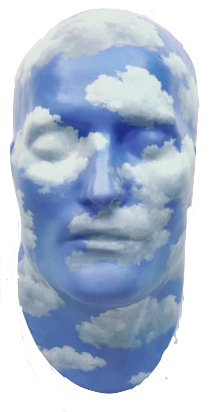
Image:
Rene Magritte
'The Future of Statues' 1937,
a mass produced plaster cast
death mask of Napoleon
hand painted by the artist
'The Future of Statues' 1937,
a mass produced plaster cast
death mask of Napoleon
hand painted by the artist



