

HOME
THINKING BLUE SKY
SKIES
WHAT IS UP THERE?
WHERE HAVE ALL THE GODS GONE?
HOW TO TAME THE SKY?
CORY ARCANGEL
LISE AUTOGENA
GASTON BACHELARD
JAMES BENNING
CORREGGIO
GILLES DELEUZE
SIMON FAITHFULL
CAMILLE FLAMMARION
WERNER HERZOG
DEREK JARMAN
GERHARD RICHTER
JACQUES TATI
JOELLE TUERLINCKX
RICHARD WILSON
PETER WEIR
QUADRATURA
WHAT OF OUR PLANETARY SKY?
ABOUT
REFERENCES
SIMON FAITHFULL Behind the sky
On 12th April 1961, traveling in Vostok 1, Yuri Gagarin became the first man in Space. He also became the first man to travel behind the blue sky: he saw the earthly sky from a shifted perspective experiencing it as a 'narrow belt girdling the globe'. I first grasped the significance of the latter of these two achievements when watching a live event by contemporary artist Simon Faithfull who, determined to understand what it was like to travel behind the sky, produced a series of ‘escape vehicles’.
Unlike Vostok, Faithfull’s Escape Vehicle was a lo-fi mechanism consisting of an atmospheric weather balloon attached to a balsa wood chair and, strung between the two, a direct-relay camera. It was No.6 in the series that I witnessed being launched from Farnborough’s disused Royal Aircraft Establishment (RAE). Its rise was rapid. As the weather balloon vanished from sight behind the clouds the small group of spectators moved into a nearby hangar to view the footage captured by the ascending camera. This was shown in real-time on a large screen. We witnessed a landscape fall away below the camera lens until any remaining features of landmass disappeared behind a haze of cloud. After an exhilarating few minutes of turbulent movement, the curvature of the earth and the sky became apparent. A beautiful bowing of the horizon-line rocked back and forth across the screen. As the ascent continued the wind grew stronger and the chair danced erratically before our eyes. Suddenly the picture seem to change, half of the screen appeared to drop away to sheer blackness, the other half was blue. This semi-voided image was visible for just a few moments before the relay cut dead. The balloon had burst and transmission ceased. The escape attempt, what Faithfull recognised from the outset as a suicide mission, had come to an abrupt end.
What had we witnessed in these last fleeting seconds of ascent? Had No.6’s camera only relayed partial data as it was buffeted around at the edge of the earth’s atmosphere? I emailed the artist whose reply stated that what we had witnessed WAS the edge. What we had seen in these last few moments of transmission was an image in which the blue atmosphere of earth met the black of Outer Space. Fifty minutes after its release from a field somewhere in Hampshire, No. 6 had arrived at a border and for a fraction of a second showed us that the sky appears not only as a deep ocean of blue but also as a fragile threshold of blue/black.
An extract from ‘Blue-Sky Thinking’, a chapter in Ricarda Vidal and Ingo Cornils (eds), Alternative Worlds (Oxford:Peter Lang, 2015)
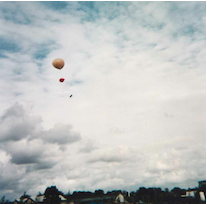
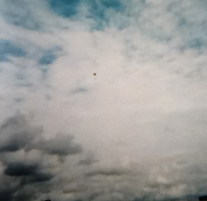
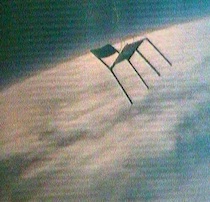
Images
of ‘Escape Vehicle No.6’ (2004). The top two are
taken from the ground watching the ascent and the
bottom image is a screen grab from Escape Vehicle's
direct relay camera.




