


HOME
THINKING BLUE SKY
SKIES
WHAT IS UP THERE?
WHERE HAVE ALL THE GODS GONE?
HOW TO TAME THE SKY?
CORY ARCANGEL
LISE AUTOGENA
GASTON BACHELARD
JAMES BENNING
CORREGGIO
GILLES DELEUZE
SIMON FAITHFULL
CAMILLE FLAMMARION
WERNER HERZOG
DEREK JARMAN
GERHARD RICHTER
JACQUES TATI
JOELLE TUERLINCKX
RICHARD WILSON
PETER WEIR
QUADRATURA
WHAT OF OUR PLANETARY SKY?
ABOUT
REFERENCES
QUADRATURA The architecture of heaven
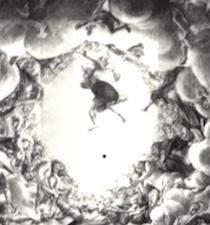
From the Renaissance onwards ceilings and cupolas were painted so as to give the impression they opened skywards. These painted spatial dimensions could be found in any self-regarding religious or civic building throughout Europe during the Baroque and Rococo periods. Correggio’s The Assumption of the Virgin (1526-30) is an early example of the style that was later mastered and written of by Baroque painter and architect Andrea Pozzo (1642-1709). What these ceilings had in common was an illusionistic Trompe-l’oeil image depicting layers of celestial architecture unfurling upwards. In his 'how to guide', Pozzo details techniques for painting a subject as if seen from below - 'di sotto in sù'.
A project called Quadratura (1995), initiated by artist Ed Allington in collaboration with architects Catrina Beevor and Robert Mull revisited this tradition. As with the Baroque manifestation, this modern Quadratura also made a localised heaven, although it did so by way of architectural intervention as opposed to painted illusion. In St Peter’s Church, a tiny building located in a quiet area in Cambridge, Allington and Beevor Mull Architects built a simple undecorated false ceiling. As they conceived it, this false ceiling represented a datum line, a threshold above which lay heaven. To extend this idea of heaven into the local community, ten households were identified in the neighbourhood. The residents were selected for the fact that they lived in a building with an elevation matching that of the church i.e. they had attics or extensions that existed on or above above St Peter's celestial datum line. To formalise the project, planning permission was submitted to Cambridge county council requesting legislative recognition of this heavenly datum line. Somewhat to the surprise of the creators of Quadratura the council engaged wholeheartedly replying in kind with a request for details of visitor parking provision within the celestial terrain.
To celebrate, Quadratura’s local participants or 'angels' were invited to a special ceremony at St Peter's:
On
this day the ‘angels’ ascended to the world above the
suspended ceiling via a winch emanating from the largest
opening… into the attic where, ahead of them, set in the roof…
was a second aedicule opening to the sky. ‘I’ve angled for
Cambridge’, said Joyce, as she descended smiling from wing to
wing. (Quadratura
Essays by James Roberts and David Turnbull, 1995, Commissions
East and The Architecture Gallery).
Joyce
and the others who were winched up into the attic crossed into a
celestial space, a space that was no longer just the idea or
illusion of an indefinite aerial expanse viewed from below but a
material threshold beyond which mankind can venture forth. 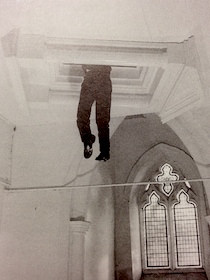
Images (top to bottom):
'Quadratura', an angel ascending into the celestial attic, St Peter’s, Cambridge; detail of Correggio’s 'Assumption of the Virgin', 1526 -30, known as an early example
of Quadratura.




