

HOME
THINKING BLUE SKY
SKIES
WHAT IS UP THERE?
WHERE HAVE ALL THE GODS GONE?
HOW TO TAME THE SKY?
CORY ARCANGEL
LISE AUTOGENA
GASTON BACHELARD
JAMES BENNING
CORREGGIO
GILLES DELEUZE
SIMON FAITHFULL
CAMILLE FLAMMARION
WERNER HERZOG
DEREK JARMAN
GERHARD RICHTER
JACQUES TATI
JOELLE TUERLINCKX
RICHARD WILSON
PETER WEIR
QUADRATURA
WHAT OF OUR PLANETARY SKY?
ABOUT
REFERENCES
LISE AUTOGENA A contemporary sky-measurer
The first time Most Blue Skies (2006) computed a set of complex data to produce a result, Lise Autogena (artist) and Josh Portway (programmer) felt the need to communicate this. It had been a long and complex process of research and development but at last there was an output. Data from satellites in orbit around the earth fed into Josh Portway’s custom-built software which was then able to calculate the most blue sky in any inhabited area of the world at any given time. Portway’s software took into account altitude, time of day, latitude and longitude, air pressure, aerosol density, water vapour density, ocean proximity and land reflection. The sky was defined as the visible spectrum horizon to horizon above any one given spot, and its blueness was measured according to degrees of saturation.
The most-blue-sky on this test-run of Most Blue Skies was in the USA, over Al’s Trailer Park somewhere in the Midwest. But how to communicate this quantitative outcome? How to mark this inaugural most-blue-sky moment? After searching, Autogena and Portway found phone numbers for some of the residents of the trailer park and made an attempt to convey their meteorological news. The artist explains that the lucky winners on this day, and others that followed, received notification of their most-blue-sky with a degree of nonchalance. Perhaps they were skeptical - Autogena’s talk of the sky could well have been the preamble to a sales pitch of some kind (life insurance, private health care, spiritual salvation). Yet the artist remembers one woman in Australia who understood the project immediately. She gave a rapturous account of the way everything was illuminated by the intense blue light. As she spoke it became apparent she was experiencing the qualitative impact of her most-blue-sky. The world around her was heightened or altered, and she was willing and able to describe this to a stranger on the phone.
The transformative effect of the blue sky has long been the subject of both scientific and artistic study. The eighteenth century physicist and sky-measurer, Horace-Bénédict de Saussure wrote of the blue vault of heaven in his Voyages in the Alps (1779-1796). He described the way the sky held "in its grandeur and its dazzling purity, an element of death and infinite sadness… the peace and complete stillness which reigned over this vast space, magnified further by the imagination, affect me with a kind of terror" (Saussure, 1834). Informed by the work of Saussure, Alexander von Humboldt argued that the burgeoning discipline of comparative climatology should include in its scope “…the degree of ordinary transparency and clearness of the sky, which is not only important with respect to the increased radiation from the earth, the organic development of plants, and the ripening of fruits, but also with reference to its influence on the feelings and mental condition of men” (Humboldt, 1845).
In the twenty-first century Josh Portway and Lise Autogena revisit the connections between the blue of the sky and the ‘feelings and mental conditions of men’. While doing so with reference to the history of these great sky-measurers, Most Blue Skies was largely driven by contemporary concerns regarding ozone depletion and climate change. Autogena argues that, in light of these facts, the blue sky has become a poignant symbol for our diminishing and damaged planet. What interests her is the impact these changes have on the sky’s connection with hope and human happiness.
In its present form, Most Blue Skies doesn’t offer an answer but shows us an averaged-out trophy sky, the sky that is most blue in the world, a product of an awe-inspiring, labour-intensive yet apparently useless process of checks and measures. This ethereal glow of pure data remains disconnected from the experience of incommensurable rapture expressed by the Australian ‘most-blue-sky’ winner. When John Tyndall successfully (re)created a blue sky in a test-tube, having first applauded the physicist for his brilliance John Ruskin went on to implore:
Ah,
masters of modern science, give me back my Athena out of
your vials, and seal, if it may be, once more, Asmodeus
therein. You have divided the elements, and united them;
enslaved them upon the earth, and discerned them in the
stars. Teach us now, but this of them, which is all that
man need know,- that the Air is given to him for his
life... (Ruskin, 1869)
Most
Blue Skies has reached a similar impasse in which
technology, having achieved something breathtaking, has
unwittingly left no way for the ungraspable to make its
presence known.Sources: an interview with Lisa Autogena, London, 19th September and www.autogena.org
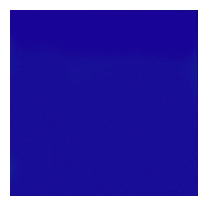
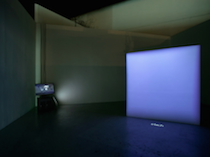
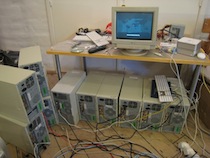
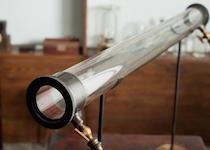
Images (from top to bottom): digital recreation of 'the bluest sky in the world 0.7 km from Apacheta, Peru' part of 'Most Blue Skies' installation; gallery installation shot of 'Most Blue Skies' (skies); gallery installation of 'Most Blue Skies' (hardware); the apparatus used in 1869 by John Tyndall to create a blue sky (image credit: Paul Wilkinson)



