


HOME
THINKING BLUE SKY
SKIES
WHAT IS UP THERE?
WHERE HAVE ALL THE GODS GONE?
HOW TO TAME THE SKY?
CORY ARCANGEL
LISE AUTOGENA
GASTON BACHELARD
JAMES BENNING
CORREGGIO
GILLES DELEUZE
SIMON FAITHFULL
CAMILLE FLAMMARION
WERNER HERZOG
DEREK JARMAN
GERHARD RICHTER
JACQUES TATI
JOELLE TUERLINCKX
RICHARD WILSON
PETER WEIR
QUADRATURA
WHAT OF OUR PLANETARY SKY?
ABOUT
REFERENCES
WERNER HERZOG A frozen threshold
Werner Herzog’s The Wild Blue Yonder (2005) is a film in which everything gets turned on its head. Film critic John Palvis uses the term 'cine-mashup', it isn't quite documentary and it isn't quite fiction (Palvis, 2006). Herzog describes it as 'a science fiction fantasy' (Herzog, 2005); a film that tells the imaginary story of two interstellar journeys. The first is undertaken by an alien race fleeing a dying planet with hopes of colonizing Earth, the other by human astronauts who set out to explore the world the aliens left behind. Brad Dourif, the alien narrator, speaking from what looks like a derelict town, tells the tale of his journey and subsequent life on earth: “This is my story… I come from the outer reaches of Andromeda… I come from another galaxy… where I come from is the wild blue yonder…” (Herzog, 2005). He talks of a journey through endless Space towards an alternative world - the planet earth. Of their arrival he says:
…we
knew we had to make this big impression, so we decided to
build this capital city one that would rival DC… over here was
to be the shopping mall (he points down a dusty deserted
street)… down there was the Pentagon (he points again)… But
the whole thing sucked. Nobody came, nobody settled, nobody
shopped… You see aliens as the technologically advanced super
beings who destroy New York City in two minutes flat… well, I
hate to say this but we aliens all suck… I guess we are just
failures… This whole thing makes me sad… really makes me sad…
(Herzog, 2005).
Juxtaposed with this dystopic account of the dreams and the ultimate failures of the aliens are various documentary interviews with key figures in the NASA programme. A pivotal moment that captures the mood of the whole film can be found in an interview with Martin Lo, a research scientist working in NASA’s Jet propulsion laboratory. Appearing to respond to a question about what a Space colony might look like Martin Lo describes a large dome in an Amazonian setting. He suggests that the main feature might be “a shopping mall in Space, because you have everything, you could shop all day long, this might be… the perfect space colonisation paradigm” (Herzog, 2005). As he finishes speaking, Herzog cuts back to the deserted town and Brad Dourif standing in front of his failed shopping mall. Dourif mumbles in despair “shopping mall! I could have told them… it makes me so sad” (Herzog, 2005).
The Wild Blue Yonder is a film that asks the question Why? Why colonise in order to replicate an earthly model of capitalist modernity? Do we really need more square footage of retail outlet? In the credits, and I believe without irony, Herzog thanks NASA for its 'sense of poetry': he appears to recognise the sheer imagination required to believe that the dreamworld of a wild blue yonder can be attained. Yet it is clear that Herzog is challenging us to rethink our conceptions of an imaginary beyond as it is made manifest in our contemporary Space Age. While this challenge can be found in the mashed-up, dystopic narrative of the film, it can also be found in the image of the sky he makes visible on screen. The sky he shows us is no idealised space of dreams. Herzog’s sky is a frozen divide of ice.
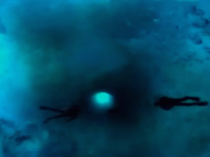
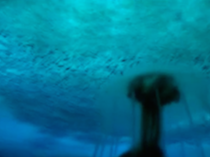
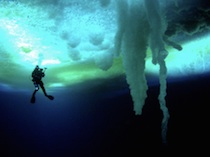
This sky appears in the last part of the film in which we witness the earthly astronauts begin to explore their dream planet. We watch as they breach the ice-sky of Andromeda and swim in its liquid atmosphere. In the suspended disbelief of the fiction we understand that the human astronauts have arrived in the skies the aliens left behind. Yet it is also evident that what we are watching is documentary footage shot on Earth. We know it is the earth’s ocean we see on the screen, specifically that of Antarctica as filmed by Henry Kaiser. In what John Pavis describes as “the world’s first undersea outer-space sci-fi documentary” (Palvis, 2006), Herzog conflates the idea of a 'wild blue yonder' and the 'here and now' for in the 'mash-up' of the film any distinction between earth and other, up and down, outside and inside gets lost. The only thing that is certain is the presence of an icy membrane of a sky marking difference itself.
An extract from ‘Blue-Sky Thinking’, a chapter in Ricarda Vidal and Ingo Cornils (eds), Alternative Worlds (Oxford:Peter Lang, 2015)
Images:
stills from the documentary footage of Antarctica shot by Henry Kaiser as featured in the final scenes of
'The Wild Blue Yonder' (2005)




