
HOME
THINKING BLUE SKY
SKIES
WHAT IS UP THERE?
WHERE HAVE ALL THE GODS GONE?
HOW TO TAME THE SKY?
CORY ARCANGEL
LISE AUTOGENA
GASTON BACHELARD
JAMES BENNING
CORREGGIO
GILLES DELEUZE
SIMON FAITHFULL
CAMILLE FLAMMARION
WERNER HERZOG
DEREK JARMAN
GERHARD RICHTER
JACQUES TATI
JOELLE TUERLINCKX
RICHARD WILSON
PETER WEIR
QUADRATURA
WHAT OF OUR PLANETARY SKY?
ABOUT
REFERENCES
DEREK JARMAN Beyond Image
You
say to the boy open your eyes
When he opens his eyes and sees the light
You make him cry out. Saying
O Blue come forth
O Blue arise
O Blue ascend
O Blue come in…
These
are the opening lines of Derek Jarman’s Blue
(1993), a work reputedly conceived when first seeing a
monochrome painting by Yves Klein. Blue
is a monochrome film. For seventy-four minutes we watch a single
colour pulse and flicker in front of us. As we adjust to the
blue of the film, we hear Jarman’s voice “you say to the boy
open your eyes…” and we too open our eyes as we adapt to this
ganzfeld, this total plane of colour that throbs in front of us.
We know that this film is ‘something’, it has both a physical
and a temporal framework, yet what we are watching is also
'nothing'.When he opens his eyes and sees the light
You make him cry out. Saying
O Blue come forth
O Blue arise
O Blue ascend
O Blue come in…
Blue is a monochrome meditation on the colour blue with clear echoes of Yves Klein's own writings. Jarman states: "In the pandemonium of image I present you with the universal Blue" and he asks the audience to consider the way blue allows us to shake off "the solumn geography of human limits” and thus to become "an astronaut of the void" (Jarman, 1993). As we melt into blue we are reminded of what it feels like to dream while contemplating a sky, something James Benning allows us to do as we adsorb the texture of his film, Ten Skies (2004). Both Jarman's blue and Benning's skies create an experience best described as a form of abstract watching: within the constraints of the screen and the duration of the film we encounter a subject that Benning writes of as 'continuous and infinite'. We watch an abstraction and, as Jarman described it, the experience is akin to 'becoming blind, thinking blind'.
If Jarman took his inspiration from Yves Klein's monochrome paintings then he also took inspiration from Yves Klein's skies. Klein collapsed the distinction between the sky and a monochromatic surface claiming that in “the blue of the sky in Nice" lay "the origin of my career as a monochromist” (Klein, 1974). He wrote of the shocking discovering that painted skies attributed to Giotto were simultaneously monochromatic: "Even if Giotto had only the figurative intention of representing a clear, cloudless sky, that intention is monochrome all the same" (Klein, 1959). In reverse we could argue that even if Jarman's intention is monochrome the result is sky-like all the same. However, Jarman's monochrome film achieves something markedly different to Klein. He doesn't leap headlong into immateriality but his aesthetics are those of the threshold. For seventy-four minutes Jarman stands firm in his own body and looks unflinchingly into the void. In doing so he creates a film that is both ethereal and visceral.
Blue is a complex film which has much to teach us, some of what we can learn relates to the aesthetics of our contemporary blue sky.
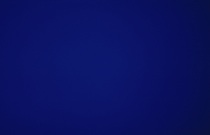
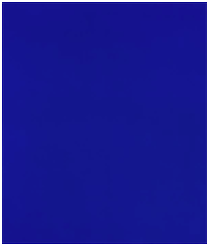
Images (top to bottom): still from Derek Jarman, Blue, 1993
original shot on 35mm film, 75 minutes: Yves Klein, YKB 79, 1959,
Paint on Canvas on plywood,
Tate Collection




