



HOME
THINKING BLUE SKY
SKIES
WHAT IS UP THERE?
WHERE HAVE ALL THE GODS GONE?
HOW TO TAME THE SKY?
CORY ARCANGEL
LISE AUTOGENA
GASTON BACHELARD
JAMES BENNING
CORREGGIO
GILLES DELEUZE
SIMON FAITHFULL
CAMILLE FLAMMARION
WERNER HERZOG
DEREK JARMAN
GERHARD RICHTER
JACQUES TATI
JOELLE TUERLINCKX
RICHARD WILSON
PETER WEIR
QUADRATURA
WHAT OF OUR PLANETARY SKY?
ABOUT
REFERENCES
JACQUES TATI A modern sky
The way in which modern life depletes and constrains our imaginary worlds is a theme Jacques Tati addressed in his 1967 film, Play Time. The ‘play’ of the title indicates the film’s ‘call to arms’ and the image of the blue sky operates as a motif for this exploration of the role of the imagination in contemporary culture.
The film opens with a long shot of a cloudy deep blue sky. The gently changing image could have been a subject of Gaston Bachelard’s study of the poetics of air; Bachelard argued that “when the aerial imagination is awakened, then the background becomes active” (Bachelard 1943, p.164). For a full two minutes we watch the gentle flux of clouds behind the titles, but as the title sequence ends Tati’s camera slowly pans from pulsing background toward a building resembling Orly Airport. We follow as he zooms in on a clean-edged corridor and two Sisters of Charity gliding towards us. Flapping cornets give the impression of angelic flight. The free-form jazz that accompanied the title sequence morphs into a celestial choir and, as it does, the pulsating blue and white depths of the sky become a monochrome, grey surface of pristine architecture. Its chromatic uniformity is punctured only by the flashing red lights of technology: intercoms, lifts and telephones. Have we arrived in a Powell and Pressburger version of heaven?
Tati never returns to the title sequence sky but uses this gentle introduction to offset the bleak banality of the urban landscape to which he turns within the body of the film. Play Time speaks directly to, and of, the blue-sky thinking of modernity’s urbanism as it emerged in post-war France. Le Corbusier’s conception of a modern city, characterised by elevation and light, informs this era of architectural planning. For Le Corbusier the soaring form of the skyscraper represented purity and harmony. His epically scaled urban plans included floating buildings of glass and steel that reflected the sky while lifting inhabitants heavenwards. It is this vision of the future that Jacque Tati critiques. Tati shows how these buildings, intended to purge the urban environment of chaos and squalor, result in blandness and uniformity. Whether divided by the glass of the TV screen or wall-to-wall windows, the lives of Tati’s urban dwellers appear sanitised and segregated. A new world has been realised and it is not what was promised.
An extract from ‘Blue-Sky Thinking’, a chapter in Ricarda Vidal and Ingo Cornils (eds), Alternative Worlds (Oxford: Peter Lang, 2015)

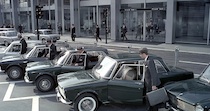
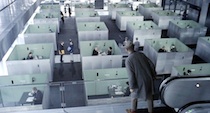
Images: stills from 'Play Time' (1967)




